

Additives. For some, they’re neat codes that show a substance has been approved in Europe. For others, they’re a red flag that makes you put the product back on the shelf. The truth? It lies somewhere in between. Let’s take a closer look at what additives are, why they exist – and why organic food takes such a critical stance on them.
What Are Additives?
The “E” in an E-number stands for Europe. An additive is a food substance that, after assessment by EFSA (the European Food Safety Authority) and approval by the European Commission, can be used in food. In the Netherlands, the NVWA (Netherlands Food and Consumer Product Safety Authority) monitors their correct use and labelling.
The idea: clarity and control. The reality: more than 350 substances ranging from vitamin C (E300) to brightly coloured dyes and artificial sweeteners.
Why Are They Used?
Additives make products look better, last longer, or be easier to process. Think of:
Convenient for the food industry, but it raises questions: does a product really need this much processing to be appealing?
The Downside of Additives
Yes, additives are legally approved. But let’s be honest: “permitted” doesn’t automatically mean “healthy” or “natural.” Many additives are synthetic and often used to mask something else: fading colour, weak flavour, or raw materials of lower quality.
In the supermarket you’ll find products that would lose their appeal without these substances. Neon colours, artificial flavour bombs, and long shelf lives often hide the fact that the base ingredients are processed or depleted. As consumers, we’re misled: it looks better, tastes stronger, and lasts longer than it naturally should.
Organic food takes a radically different approach. If a product only stands up thanks to artificial additives, something is wrong. Organic puts the raw material at the centre: pure, recognisable, and minimally processed. That’s why in the organic sector only about 50 out of more than 350 additives are allowed – and only if they:
Artificial colourings, flavourings, and flavour enhancers are simply forbidden.
Examples from the Organic Kitchen
Examples of permitted additives with a natural origin include:
At Amaizin we only add what is truly necessary. In our wraps, for instance, we use E322 (sunflower lecithin), which keeps them soft and flexible instead of breaking. A natural helper that guarantees quality.
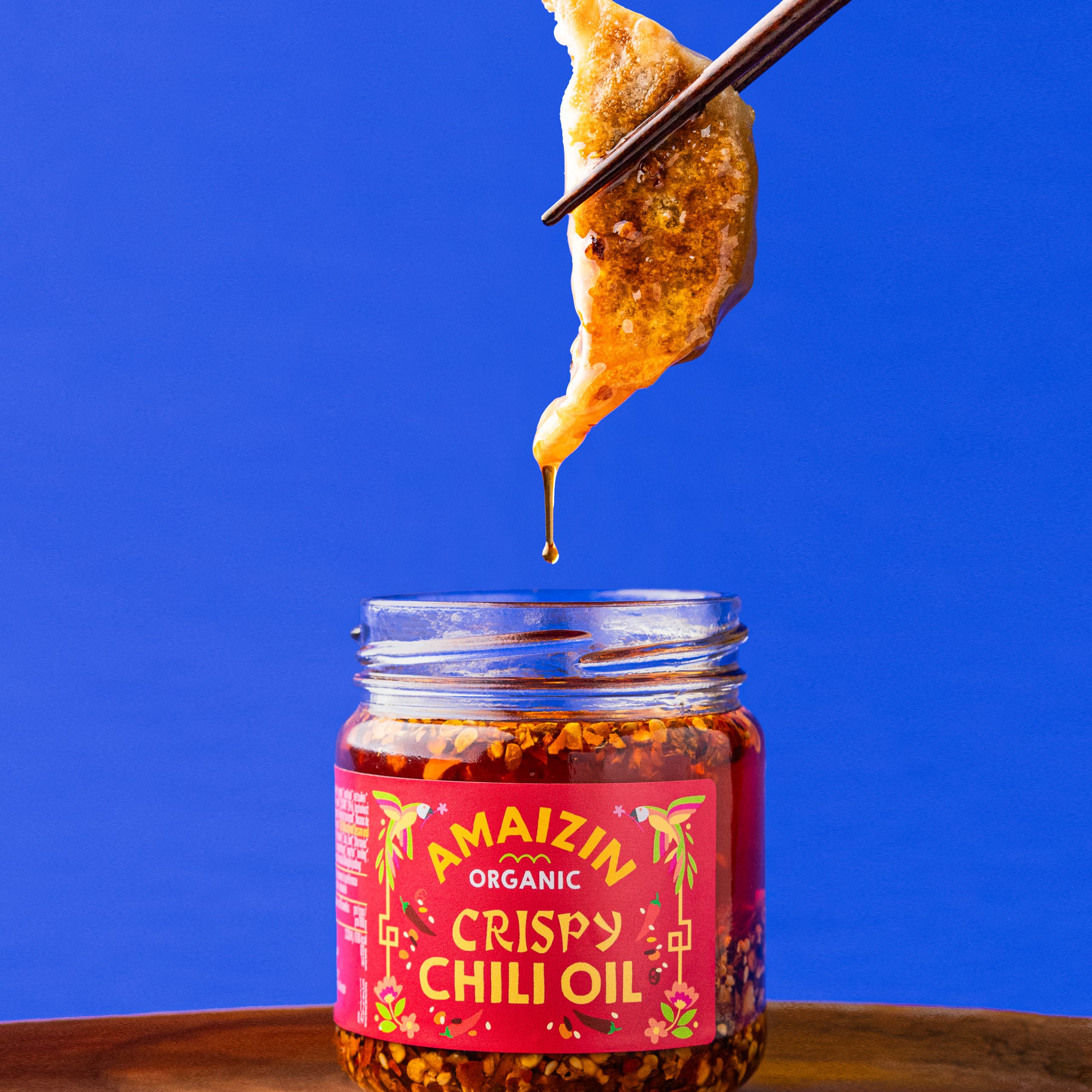
But more often, we prove it can be done without. Our Crispy Chili Oil is made purely with oil, chili and spices – no unnecessary additives. Proof that real flavour doesn’t need colouring agents or flavour enhancers.